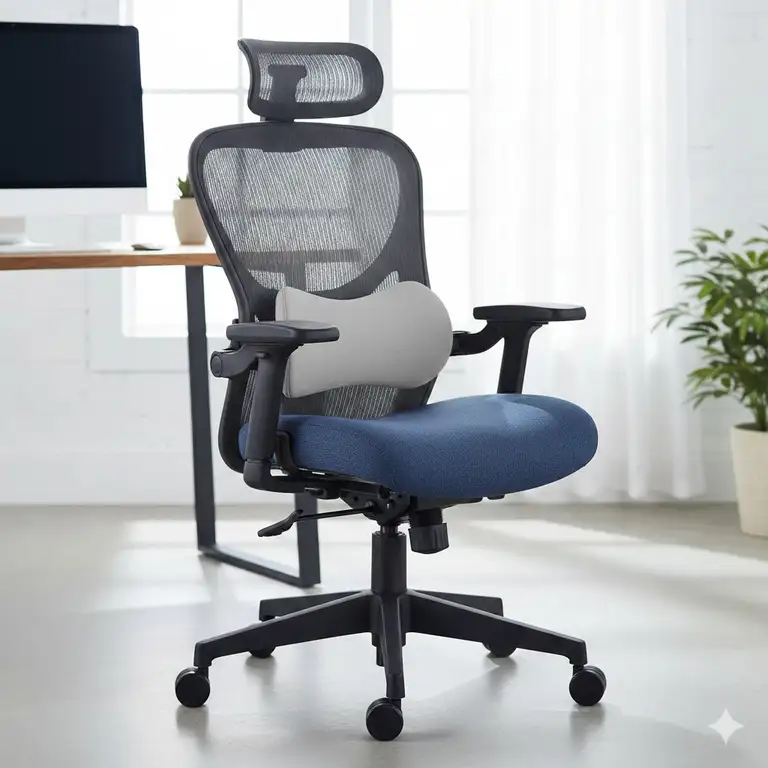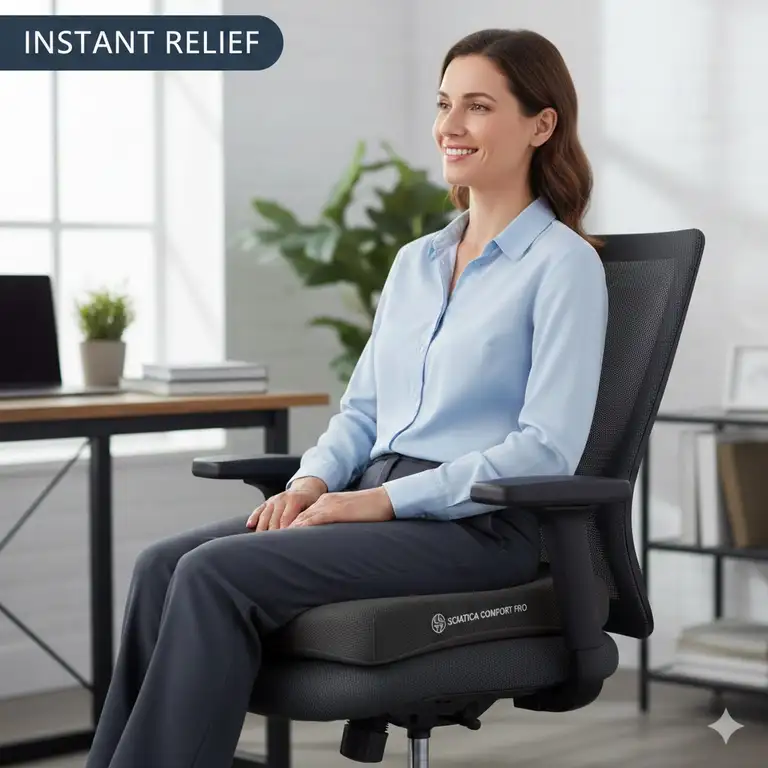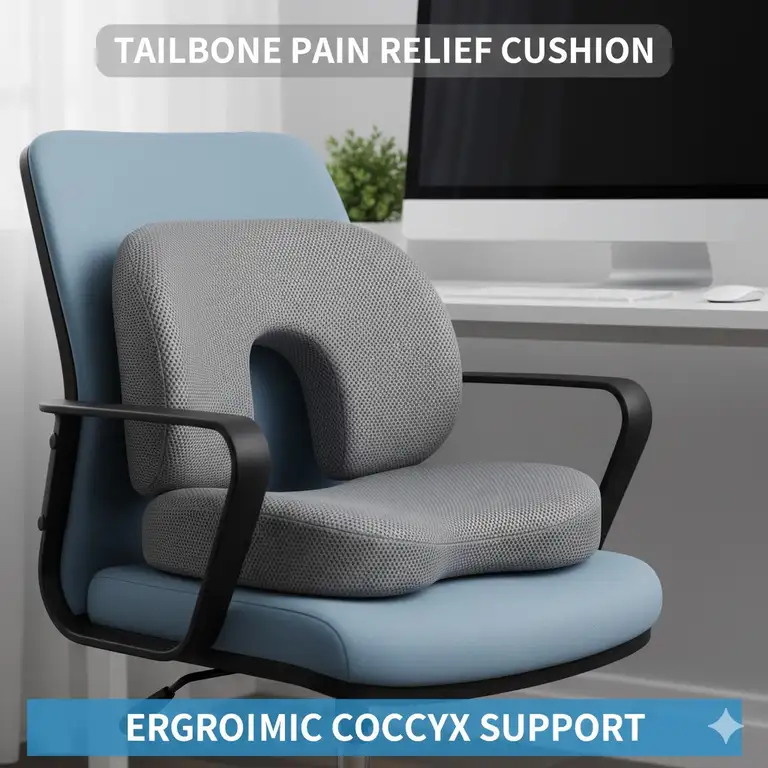
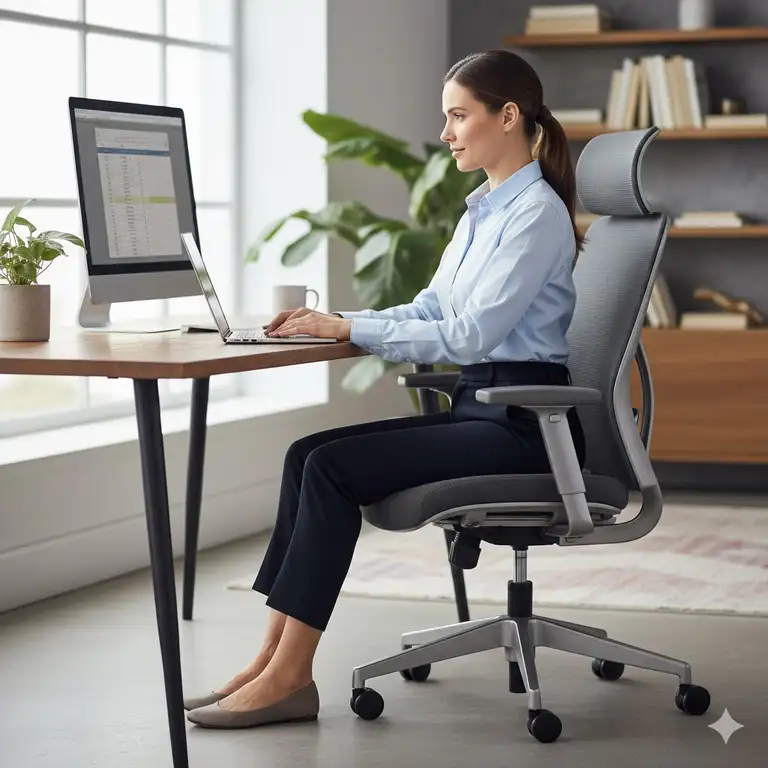
Let’s be real. That dull, throbbing ache in your lower back that radiates into your hip? It’s not just an “ouch” moment; it’s a full-on, day-ruining, focus-stealing nightmare. You shift, you squirm, you stuff a pillow back there, but the pain just digs in. If you spend your days at a desk, you know this feeling all too well. Your chair, that thing you trust to support you, is secretly betraying you.
✨Was this helpful? Spread the word! 🚀
But here’s the good news: the right chair isn’t just a piece of furniture; it’s a tool. The best chair for lower back and hip pain can completely change your workday, turning agony into “ahhh.” I’ve spent countless hours researching, sitting, and analyzing what separates a $50 pretender from a true ergonomic champion. This guide is the result of that deep dive, designed to help you find the exact chair that fits your body, your pain, and your budget. We’ll look at chairs for lower back and hip pain, explore options for just lumbar issues, and find the perfect computer chair for back problems.
Before we get into the detailed reviews, let’s look at the core problem. What you’re feeling isn’t just “in your head”—it’s a real, physical response to poor support.
Pain Points vs. Ergonomic Solutions
| Your Pain Point 😫 | The Ergonomic Solution 💡 | Why It Works |
| Dull ache across the lower back | Adjustable, Dynamic Lumbar Support | It pushes gently on your lumbar spine (L1-L5), helping you maintain a natural “S” curve instead of slumping into a “C.” |
| Sharp pain in the hip/buttocks | Contoured Seat Cushion / Seat Depth Adjustment | A good cushion (especially memory foam or high-density foam) distributes weight evenly. Seat depth ensures you’re not cutting off circulation. |
| Pain/numbness down the leg (Sciatica) | Waterfall Seat Edge | This rounded front edge reduces pressure on the back of your thighs, promoting better blood flow and preventing nerve compression. |
| Shoulder and neck stiffness | 4D Adjustable Armrests | By aligning armrests with your desk, you let your shoulders relax. This stops you from “shrugging” all day, which tenses your neck. |
| General “stuck” feeling | Synchro-Tilt or Center-Tilt Recline | This allows your whole body to move, opening up your hips and back as you lean, which is crucial for preventing stiffness. |
🚀 Quick Comparison: Top Chairs for Lower Back and Hip Pain
Pressed for time? Here is a quick overview of the top contenders. We’ll dive much deeper into each one, but this gives you a starting point.
| Model | Best For | Key Feature | Pain Focus |
| Steelcase Leap V2 | Overall Best | LiveBack Technology & 4-Way Arms | Lower Back & Hip |
| Herman Miller Aeron | Ultimate Lumbar Support | PostureFit SL Pellicle Mesh | Lower Back & Sciatica |
| HAG Capisco Puls | Active Sitting & Hip Mobility | Saddle Seat Design | Hip Pain & Stiffness |
| Nouhaus Ergo3D | Mid-Range Adjustability | 3D Lumbar & “Just for” Recline | Lower Back & Neck |
| SIHOO M18 | Best Budget Pick | Adaptive Lumbar & Mesh Back | General Back Pain |
| DRAGONN by VIVO Kneeling Chair | Posture Correction | Angled Knee Support | Hip Flexor & Spine |
| La-Z-Boy Trafford | Big & Tall Comfort | ComfortCore Plus Foam | Overall Cushioning |
🏆 Top 7 Best Chair for Lower back and hip pain: Expert Analysis
We’ve researched dozens of models, read thousands of reviews, and cross-referenced ergonomic principles to bring you this list. These are the real-deal products available now that can make a difference.
1. Steelcase Leap V2
The Steelcase Leap V2 is consistently one of the most recommended ergonomic chairs, and for good reason. It’s less about forcing you into one “perfect” posture and more about moving with you.
-
Specifications:
-
Technology: LiveBack technology (back flexes with you)
-
Adjustments: 4-way adjustable armrests, seat depth, seat height, 5-position recline lock, lower back firmness.
-
Material: High-density foam with fabric upholstery (multiple options).
-
Warranty: Steelcase Limited Lifetime Warranty.
-
-
Customer Review Analysis: Users consistently praise the “built like a tank” quality. Many report that their back pain and hip discomfort significantly decreased after just a few weeks. The high-density foam seat is a common highlight, as it doesn’t “bottom out” like cheaper chairs, providing excellent support for the sit bones and hips. The main complaint? The price. But most conclude it’s a worthwhile investment.
-
Pros/Cons Analysis:
-
✅ Pros: Unmatched adjustability, especially the arms. Seat depth adjustment is a must-all for hip comfort. Moves with your body. Exceptional build quality and warranty.
-
❌ Cons: Premium price tag. The aesthetics are very “office-y.”
-
-
Variants: The Leap comes in a V2 (this one), a Leap Plus (for users up to 500 lbs), and a huge variety of fabric and leather colors.
2. Herman Miller Aeron
You can’t talk about ergonomic chairs without mentioning the Aeron. It’s an icon. But is it good for lower back and hip pain? Yes, especially for the back.
-
Specifications:
-
Technology: PostureFit SL (individual pads for sacrum and lumbar)
-
Material: 8Z Pellicle mesh (8 zones of varying tension)
-
Adjustments: Comes in 3 sizes (A, B, C) to fit your body, plus seat height, tilt, and 3D/4D arm options.
-
Warranty: 12-year, 24/7-use warranty.
-
-
Customer Review Analysis: People who love the Aeron really love it. The mesh is a huge selling point—it’s breathable (no sweat) and incredibly supportive. Users with sciatica and lumbar pain often call it “life-changing.” The PostureFit SL support is aggressive, in a good way. The main complaint comes from users who prefer a soft, cushioned seat. The mesh is firm.
-
Pros/Cons Analysis:
-
✅ Pros: Best-in-class lumbar support. Exceptional breathability. 12-year warranty is unbeatable. Comes in sizes for a perfect fit.
-
❌ Cons: Very expensive. The mesh seat is not for everyone (it’s firm, not plush). The frame edges can be felt by some users.
-
-
Alternatives: The Herman Miller Embody is another premium option, often preferred by those who want more freedom of movement and a slightly more forgiving seat.
3. HAG Capisco Puls
This one looks different, and that’s the whole point. The HAG Capisco is a “saddle” chair, and it’s fantastic for hip pain because it opens your hip angle.
-
Specifications:
-
Technology: Saddle-style seat
-
Adjustments: Seat height (great for standing desks), seat depth, back height, and recline tension.
-
Material: Durable plastic (Puls model) or upholstered (standard Capisco).
-
Warranty: 10-year warranty.
-
-
Customer Review Analysis: This chair is a game-changer for “active sitters.” Users love that you can sit facing forward, sideways, or backward. It’s especially popular with standing desk users. People with hip impingement or stiffness report dramatic relief because the saddle design forces a more open, “active” posture, preventing hip flexors from tightening.
-
Pros/Cons Analysis:
-
✅ Pros: Amazing for hip mobility and pain. Encourages active sitting. Perfect for sit-stand desks. Very durable.
-
❌ Cons: Takes time to get used to. Not a “lean back and relax” chair. The plastic seat on the Puls model can be hard for some.
-
-
Variants: The standard HAG Capisco has a fully upholstered seat for more cushion, while the Puls (reviewed here) is a more affordable and easier-to-clean plastic version.
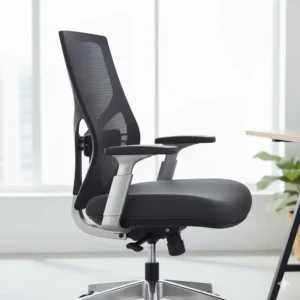
4. Nouhaus Ergo3D Ergonomic Office Chair
Looking for something that has high-end features without the four-figure price? The Nouhaus Ergo3D is a serious contender.
-
Specifications:
-
Technology: 3D “Auto-Tuning” Lumbar Support (moves with you).
-
Adjustments: 4D armrests, 135-degree recline with footrest, seat height.
-
Material: ElastoMesh (durable and breathable).
-
Warranty: 5-year warranty.
-
-
Customer Review Analysis: Users are often shocked by the value. The 4D armrests and the deep recline (with a pop-out footrest!) are features usually found on much pricier chairs. The 3D lumbar support gets positive marks for being present without being pushy. Some taller users (over 6’1″) find the headrest pushes their head too far forward, but for average-height users, it’s a dream.
-
Pros/Cons Analysis:
-
✅ Pros: Excellent value for the features. 4D armrests. Deep recline with a footrest. Stylish, modern design.
-
❌ Cons: Lumbar support isn’t depth-adjustable (it’s auto-tuning). Headrest isn’t ideal for all heights.
-
-
Budget Alternative: The Nouhaus ErgoFlip is another option with flip-up arms, but the Ergo3D provides better overall ergonomic support for pain.
5. SIHOO M18 Ergonomic Office Chair
If you’re on a tight budget but are desperate for relief, the SIHOO M18 is a frequent “best budget” winner, and it’s available all over Amazon.
-
Specifications:
-
Technology: Adaptive lumbar support (padded, U-shaped).
-
Adjustments: 3D armrests, seat height, recline, headrest height/angle.
-
Material: Breathable mesh back, fabric cushion seat.
-
Warranty: 3-year warranty.
-
-
Customer Review Analysis: The overwhelming sentiment is “great chair for the price.” It has adjustments (like 3D arms) that are rare in this price bracket. The lumbar support is noted as being comfortable and effective for moderate back pain. The seat cushion is thick and comfortable, which is good for hip comfort. The main negative is build quality—it’s good, not great.
-
Pros/Cons Analysis:
-
✅ Pros: Fantastic price. Solid feature set for the money. Comfortable seat cushion.
-
❌ Cons: Build materials feel cheaper than premium brands. Not as durable long-term. Lumbar support is not depth-adjustable.
-
-
Lesser-Known Alternative: Brands like Ticova and Gabrylly also compete heavily in this space, often with similar feature sets. The SIHOO M18 just tends to have the most consistent positive reviews.
6. DRAGONN by VIVO Kneeling Chair
This is another “alternative” chair that can work wonders for a specific type of lower back and hip pain—the kind caused by tight hip flexors.
-
Specifications:
-
Technology: Ergonomic kneeling posture.
-
Adjustments: Seat height.
-
Material: Thick foam cushions (3 inches) and a metal frame.
-
Warranty: 1-year warranty.
-
-
Customer Review Analysis: This is a “love it or hate it” product. Those who love it say it “…forced me to sit up straight” and completely eliminated their hip flexor tightness, which in turn relieved their lower back pain. It works by tilting your pelvis forward, which naturally straightens your spine. The complaints? It puts pressure on your shins (which you get used to) and it’s not for all-day sitting.
-
Pros/Cons Analysis:
-
✅ Pros: Excellent for engaging your core and improving posture. Relieves tight hip flexors. Surprisingly comfortable once you adapt.
-
❌ Cons: Puts pressure on shins. Not a primary, all-day chair. Best used in 1-2 hour bursts.
-
-
Pro-Tip: I recommend using a chair like the DRAGONN in rotation with a standard ergonomic chair. Use it for 2 hours, then switch back.
7. La-Z-Boy Trafford Big & Tall Executive Office Chair
Sometimes, pain relief isn’t about aggressive lumbar supports; it’s about plush, encompassing comfort and support. This is where the La-Z-Boy Trafford shines, especially for larger users.
-
Specifications:
-
Technology: ComfortCore Plus memory foam layers.
-
Adjustments: Standard tilt, lock, and height.
-
Material: Bonded leather.
-
Warranty: 10-year limited warranty.
-
-
Customer Review Analysis: The key word in reviews is “comfortable.” Users describe it as a “plush, supportive cloud.” The wide seat and high back are perfect for big and tall users who feel cramped in mesh “ergonomic” chairs. The memory foam layering is fantastic for hip and tailbone pain, as it eliminates pressure points.
-
Pros/Cons Analysis:
-
✅ Pros: Exceptionally plush and comfortable. Great for big and tall users. Wide seat prevents hip pinching.
-
❌ Cons: Lacks advanced ergonomic adjustments (like 4D arms or seat depth). Bonded leather can peel over time. Not very breathable.
-
✨ Don’t Miss These Exclusive Deals!
🔍 Take your office comfort to the next level with these carefully selected chairs. Click on any highlighted item to explore detailed specs, read user reviews, and check current pricing on Amazon!
💬 Just one click – help others make better buying decisions too!😊
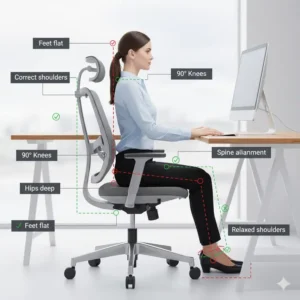
🧠 Why Your Chair Is Hurting Your Hips and Back (The Science Bit)
You’d think sitting, the act of not moving, would be easy on the body. It’s the opposite. Here’s what’s happening to you:
-
Static Posture: When you sit, especially in a bad chair, your muscles are in a state of static load. They aren’t moving, but they are firing constantly to hold you up. This leads to fatigue, knots, and pain.
-
The “C” Slump: A chair without good lumbar support lets your pelvis roll backward. This flattens the natural “S” curve of your spine into a slumped “C” shape. This puts massive pressure on your lumbar discs, the cushions of your spine.
-
Hip Flexor Compression: This is a huge one for hip pain. When you sit at 90 degrees, your hip flexors (the muscles at the front of your hip) are in a shortened, contracted position. Over time, they become tight. When you stand up, those-tight-muscles pull your pelvis forward, straining your lower back. This is why a desk chair for lower back and hip pain often needs a good recline or a seat that opens your hip angle.
A 2017 study from the National Institutes of Health (NIH) on musculoskeletal disorders highlighted that prolonged sitting is a major risk factor. The solution isn’t to stop sitting; it’s to sit dynamically in a chair that supports a healthy posture.
🔬 Decoding Ergonomics: What Actually Matters for a Lower Back and Hip Pain Chair
“Ergonomic” is a marketing word. Let’s talk about the features that actually fix the pain.
-
Dynamic Lumbar Support: This is the #1 most important feature. Look for a chair where the lumbar support is height-adjustable (to hit your specific back curve) and ideally, depth-adjustable (to change the pressure). The Steelcase Leap‘s “LiveBack” or the Aeron‘s “PostureFit SL” are prime examples.
-
Seat Depth Adjustment: This is critical for hip pain and sciatica. If your seat is too long, it cuts into the back of your knees. If it’s too short, it doesn’t support your thighs. You should be able to fit 2-3 fingers between the edge of the seat and the back of your knee.
-
Waterfall Seat Edge: Look at the front of the seat cushion. It should curve down. This waterfall edge is vital for preventing the seat from cutting off circulation in your legs, which can lead to numbness and aggravate hip issues.
-
4D Armrests: This sounds like overkill, but it’s not. 4D (height, width, depth, and pivot) armrests let you bring support to your arms. This stops you from hunching your shoulders, a major source of upper back and neck pain, which is often related to lower back issues.
Ergonomic Features vs. Pain Relief Benefits
| Feature | How It Helps Your Back | How It Helps Your Hips |
| Adjustable Lumbar | Maintains the natural “S” curve of your spine, reducing disc pressure. | By keeping your spine aligned, it prevents your pelvis from tucking under. |
| Seat Depth Adjust | Prevents you from slouching to find support. | Ensures your weight is on your “sit bones,” not your hamstrings or tailbone. |
| Waterfall Edge | Reduces pressure on thighs, improving blood flow and preventing leg numbness. | |
| Synchro-Tilt | Encourages movement, re-oxygenating the muscles in your back. | Opens the hip angle (beyond 90 degrees) when you recline, stretching hip flexors. |
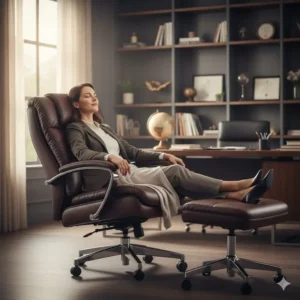
🩺 Finding the Best Office Chair for Lumbar Pain (In-Depth)
When your primary complaint is that deep, nagging ache in your lower back, you need to focus on one thing: lumbar support. This is the key difference between a cheap chair and the best office chair for lumbar pain.
But not all lumbar support is created equal.
-
Fixed Lumbar: This is a static curve built into the chair’s back. It’s better than nothing, but it’s a “one-size-fits-all” approach that rarely fits anyone perfectly.
-
Adjustable Lumbar (Height): This is a big step up. It’s usually a pad or piece that slides up and down. This lets you position the support right in the “small” of your back. The SIHOO M18 has a good version of this.
-
Adjustable Lumbar (Depth/Tension): This is the next level. You can control how much the support pushes against you. The Steelcase Leap has a “firmness” dial that does this.
-
Dynamic/Adaptive Lumbar: This is the holy grail. Instead of you adjusting the chair, the chair adjusts to you. The Herman Miller Aeron‘s PostureFit SL has two distinct pads that flex and move as you shift, supporting both your lumbar and your sacrum. This is as good as it gets.
Adjustable vs. Dynamic Lumbar Support
| Support Type | How It Works | Best For… | Example Product |
| Adjustable (Manual) | You set the height and/or depth and it stays there. | People who “set it and forget it” and have a consistent posture. | Steelcase Leap V2 |
| Dynamic (Automatic) | The support flexes, pivots, or shifts as you move. | Active sitters who shift a lot and want constant, responsive support. | Herman Miller Aeron |
When shopping, if you see “best office chair for lumbar pain” in a description, dig deeper. Ask how it’s adjustable. If it’s not, they’re just using keywords.
💻 The Search for the Best Computer Chair for Back Problems
What’s the difference between an “office chair” and a “computer chair”? Honestly, not much. But when I hear “computer chair,” I think of long hours. Gaming, coding, writing… tasks where you are locked in for 8, 10, or 12 hours.
The best computer chair for back problems needs to support not just one posture, but many.
-
The “Forward” Task: When you’re focused, you lean in. A good chair will have a “forward tilt” option (like the Aeron and Leap) that tilts the seat pan down, keeping your hips open and your spine aligned even as you lean over your keyboard.
-
The “Relaxed” Recline: When you’re on a call or watching a video, you lean back. This is where a synchro-tilt mechanism is crucial. It means the backrest reclines at a greater ratio (e.g., 2:1) than the seat. This opens your hips and decompresses your spine.
-
The “Full” Recline: For a real break, a deep recline with a headrest and footrest is amazing. This is where the Nouhaus Ergo3D excels. It’s not for working, but it’s a fantastic feature for taking a 15-minute “micro-break” to decompress your back.
A good computer chair for back problems also must have a headrest. Staring at a monitor all day puts a huge strain on your neck. A headrest provides a place to rest your head and neck during those recline moments, preventing that “tech neck” stiffness that radiates all the way down your back.
🧘 Beyond the Standard Office Chair: Are Alternatives Better?
If you’ve tried traditional ergonomic chairs and still have pain, it might be time to think outside the 9-to-5 box. The pain from a chair for lower back and hip pain sometimes comes from the position itself.
-
Saddle Chairs (like the HAG Capisco): These are my top recommendation for hip pain. By dropping your knees below your hips, a saddle seat puts your pelvis in a neutral “standing” position while sitting. This completely eliminates that hip flexor compression. It feels weird for two days, and then it feels amazing.
-
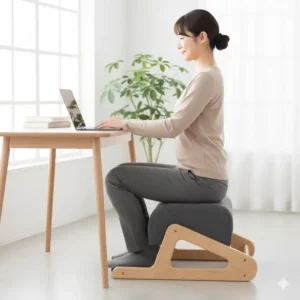
Kneeling Chairs (like the DRAGONN): These work on a similar principle, tilting your pelvis forward to align your spine. They are fantastic for forcing you to engage your core muscles. The trade-off is pressure on your shins. I stand by my earlier advice: use this as a “second chair” to rotate with your primary one.
-
Standing Desks: The best “chair” might be no chair at all. A standing desk, or a standing desk converter, allows you to change your position entirely. The ideal setup? A standing desk paired with a high-quality chair (like the HAG Capisco, which adjusts to standing height) and a good anti-fatigue mat.
Comparison: Standard vs. Alternative Seating
| Chair Type | How It Helps Pain | Best Use Case | Potential Downside |
| Standard Ergonomic | Supports a healthy “S” curve with adjustable lumbar. | All-day, multi-task work. | Can still lead to tight hip flexors if you don’t move. |
| Saddle Chair | Opens the hip angle to >110 degrees, decompressing hip joints. | Active work, standing desks, creative tasks. | Takes getting used to; less “lounging” comfort. |
| Kneeling Chair | Tilts pelvis forward, stacking the spine naturally. Engages core. | Short-term (1-3 hour) focus tasks. | Puts pressure on shins; not for all-day use. |
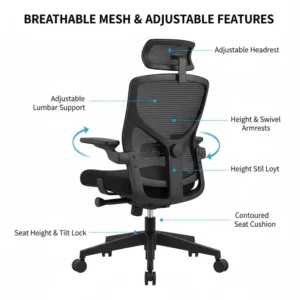
🛠️ How to Set Up Your New Ergonomic Chair Correctly
You can buy a $1,500 chair and still be in pain if you don’t set it up right. Follow this 5-step process.
-
Height (Feet on Floor): Adjust your seat height so your feet are flat on the floor, with your knees at a 90 to 100-degree angle. Your thighs should be parallel to the floor.
-
Depth (Fingers at Knee): Sit all the way back. Adjust the seat depth so you can fit 2-3 fingers between the edge of the chair and the back of your knees.
-
Lumbar (Small of Back): Adjust the lumbar support height so it fits perfectly into the small of your back (your “lordotic curve”). If it has depth/tension, set it to be “supportive, not pushy.”
-
Armrests (Elbows at 90): Adjust the armrests so they are at the same height as your desk. Your elbows should be at a 90-degree angle, and your shoulders should be completely relaxed. This is the step most people get wrong.
-
Recline: Set your recline. Don’t lock it upright all day. Set a light tension so the chair moves with you, or unlock it for 10-15 minutes every hour to move around.
OSHA (Occupational Safety and Health Administration) has fantastic, no-nonsense guides on this. Their core principle is supporting a neutral, “low-stress” posture.
Common Setup Mistakes and Fixes
| Mistake | The Problem It Causes | The Fix |
| Sitting too high (“Dangling feet”) | Numbness in legs, pressure on thighs. | Lower the chair. If your desk is too high, use a footrest. |
| Sitting too low (“Knees in chest”) | Strains lower back, closes hip angle. | Raise the chair so thighs are parallel to the floor. |
| Armrests too high | Tense shoulders, neck pain. | Lower armrests until shoulders are 100% relaxed. |
| Seat depth too long | Cuts off circulation, pushes on nerves. | Slide the seat pan back (2-3 finger gap). |
🏃 Lifestyle Habits to Complement Your New Chair
A new chair is a tool, not a magic cure. To truly solve lower back and hip pain, you need to move.
-
The 30-for-1 Rule: For every 30 minutes you sit, take a 1-minute “micro-break.” Just stand up, stretch your arms overhead, and sit back down. It’s enough to reset.
-
The Hip Flexor Stretch: This is the #1 stretch for desk workers. Kneel on one knee (like you’re proposing), and gently push your hips forward. You’ll feel a stretch in the front of the hip of the kneeling leg. Hold for 30 seconds. This is a game-changer.
-
Hydrate: Your spinal discs are like little jelly donuts. They are mostly water. When you’re dehydrated, they compress, which can lead to pain.
Integrating these small habits, as suggested by health resources from places like Cornell’s Ergonomics Web, makes your expensive chair 100% more effective.
📊 Buyer’s Guide: Feature Matrix
This table gives you a final, at-a-glance comparison of our top picks.
| Feature | Steelcase Leap V2 | Herman Miller Aeron | HAG Capisco Puls | Nouhaus Ergo3D | SIHOO M18 | DRAGONN Kneeler | La-Z-Boy Trafford |
| Pain Focus | Back & Hip | Back & Sciatica | Hip & Spine | Back & Neck | General Back | Hip Flexor & Spine | Cushioning & Hip |
| Seat Type | Foam | Mesh | Plastic/Saddle | Mesh | Foam | Foam | Memory Foam |
| Lumbar | Dynamic (Tension) | Dynamic (PostureFit) | Backrest Adjust | Dynamic (3D) | Adjustable (Height) | N/A (Posture) | Fixed (Padded) |
| Seat Depth | ✅ Yes | ❌ No (Sizes) | ✅ Yes | ❌ No | ❌ No | ❌ No | ❌ No |
| Armrests | 4D | 3D/4D | Fixed (Back wings) | 4D | 3D | ❌ No | Fixed (Padded) |
| Warranty | Lifetime | 12-Year | 10-Year | 5-Year | 3-Year | 1-Year | 10-Year |
| Best For | All-Day, All-Round | Tasking, Breathability | Active/Standing Desk | Mid-Range, Reclining | Budget Buyers | Posture Correction | Big & Tall, Comfort |
💰 Cost vs. Benefit Analysis
Is a $1,000 chair really worth it? Let’s break it down.
| Price Tier | What You Get | What You Don’t Get | The Verdict |
| Budget ($150-$300) | Basic adjustments (height, tilt). Mesh back. Fixed lumbar. | Seat depth adjustment, 4D arms, durable materials. 1-3 year warranty. | Good for 1-2 hours a day. SIHOO is at the top of this class. |
| Mid-Range ($350-$700) | Good adjustments (3D/4D arms). Better foam. Decent lumbar. 3-5 year warranty. | Dynamic support. Premium build. Lifetime warranty. | The sweet spot for many. The Nouhaus Ergo3D lives here. |
| Premium ($900+) | Best-in-class materials. Dynamic, responsive support. 10-Year to Lifetime warranties. | An investment. If you sit 8+ hours a day, a Leap or Aeron is cheaper than physical therapy. |
✨ Ready to Finally Sit Comfortably?
🔍 You’ve seen the science, now get the solution. Click on the Nouhaus Ergo3D or the Steelcase Leap V2 to see how their recline features can revolutionize your workday. Check specs and reviews on Amazon now!
🎉 Conclusion: Your Best Sit is Yet to Come
Finding the best chair for lower back and hip pain isn’t about finding the most expensive or complicated chair. It’s about finding the right chair for your body and your pain.
-
If you need the best all-arounder, I’d point you to the Steelcase Leap V2.
-
If your pain is 90% in your lower back, the Herman Miller Aeron is a specialized tool for the job.
-
And if your hips are your main enemy, the HAG Capisco could be a revelation.
Don’t spend another day in pain. Your work is important, but your health is essential. Upgrading your chair is a direct investment in your well-being.
❓FAQs
✅ For hip bursitis, you need a chair that reduces pressure on the trochanter (the outside of the hip). A chair with a thick, high-density foam or memory foam cushion, like the La-Z-Boy Trafford, is ideal. A seat depth adjustment is also key to avoid pressure...
✅ It depends on your pain. Herman Miller Aeron is often better for specific, sharp lumbar pain due to its aggressive PostureFit SL support. Steelcase Leap V2 is often better for overall back and hip discomfort, as its flexible back and plush seat move with you...
✅ Yes, a kneeling chair can be excellent for hip pain caused by tight hip flexors. By opening your hip angle to over 90 degrees, it relieves compression. However, it's not an all-day chair, as it places pressure on your shins. Use it in rotation...
✅ The SIHOO M18 is a strong budget choice. It offers a height-adjustable lumbar support and a thick, comfortable seat cushion, which are the two key features for budget-level relief. It also has adjustable armrests to help your upper back and shoulder posture...
✅ A waterfall seat edge is a rounded, sloping front on the seat cushion. It's crucial for lower back and hip pain because it prevents the seat from cutting off circulation in your legs, which can lead to numbness, tingling, and sciatica... ❓ What's the best office chair for hip bursitis?
❓ Herman Miller vs Steelcase for back pain: which is better?
❓ Is a kneeling chair good for hip pain?
❓ What's a good budget ergonomic chair for back and hip pain?
❓ What is a waterfall seat edge and why do I need it?
Recommended for You
- Best Chair for Lower Back Pain at Home: 7 Top Picks 2025
- Wood and Leather Office Chair: 7 Premium Picks 2025 for Luxury Comfort & Style
- 7 Best Office Chair for Back Pain: Tested & Approved
Disclaimer: This article contains affiliate links. If you purchase products through these links, we may earn a small commission at no additional cost to you.
✨ Found this helpful? Share it with your friends! 💬🤗