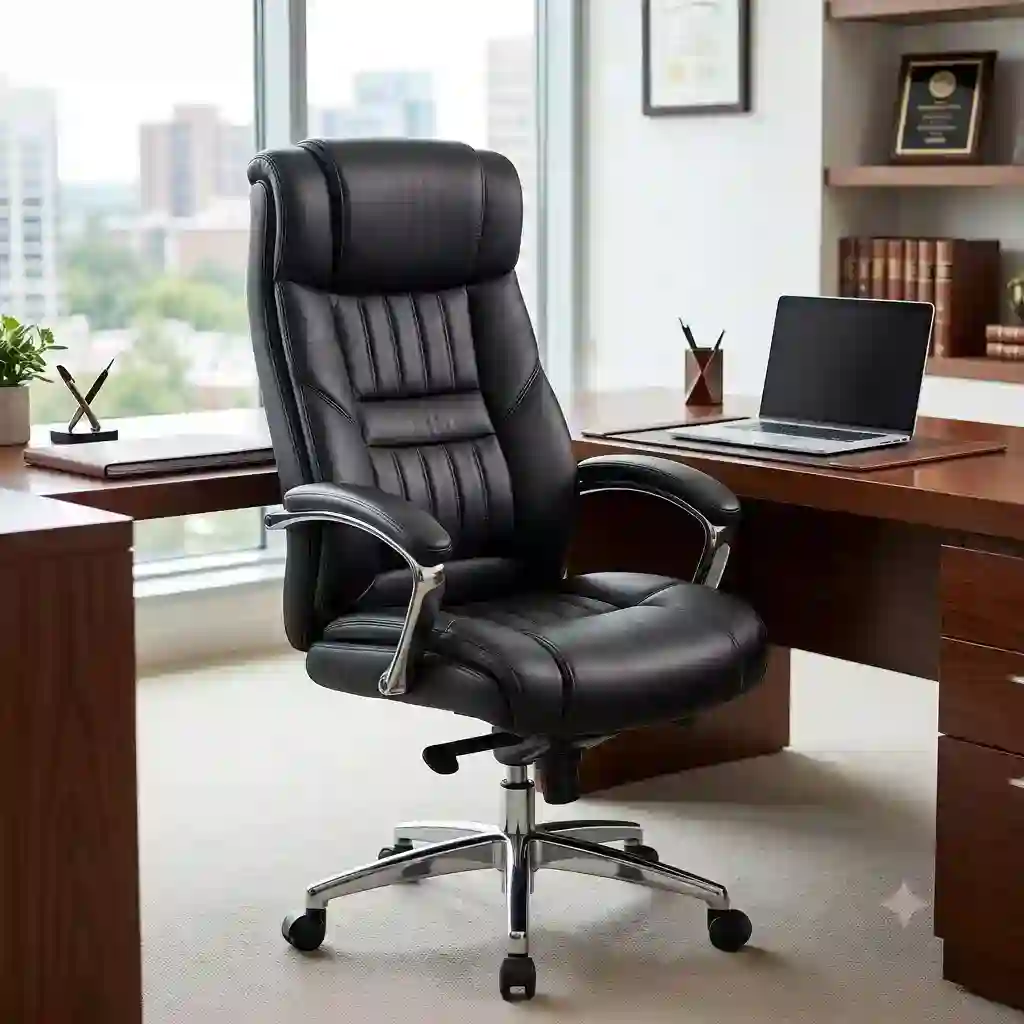
Let’s cut right to the chase: picking out workspace seating isn’t just about finding something to park yourself in for eight hours. In my ten years as an ergonomic workspace consultant, I’ve seen countless trends come and go. Yet, the demand for high-quality black leather office chairs remains unwavering. They command respect, exude professionalism, and when designed correctly, offer unmatched longevity.
But here is the harsh reality most marketing materials won’t admit: not all of them are built the same. A chair might look like a million bucks on a website but feel like a medieval torture device after a three-hour Zoom marathon. Furthermore, the modern shift toward hybrid work has forced manufacturers to blur the lines between traditional executive desk chairs and high-performance ergonomic task seating.
In my field tests, evaluating everything from $150 big-box store specials to $2,000 bespoke masterpieces, I’ve learned that the true value of a chair hides in its cylinder class, foam density, and stitching patterns—not just its silhouette. What is a high-quality leather chair? It is a functional piece of equipment that actively reduces spinal compression while regulating your body temperature. In this guide, we are going beyond the spec sheets. I will walk you through exactly what you need to know, what to avoid, and which models actually live up to their hype in 2026.
Quick Comparison: The Heavyweights at a Glance
Before we dive into the microscopic details of stitching and lumbar support, let’s take a macro look at the current market landscape. I’ve categorized these based on months of sitting, sweating, and shifting in them.
| Model | Primary Material | Ideal User Profile | Price Tier |
| Steelcase Leap v2 | Top-Grain Leather | Ergonomic Obsessives | Premium ($1,200+) |
| La-Z-Boy Delano | Bonded Leather | Big & Tall Comfort Seekers | Budget/Mid (Under $400) |
| Humanscale Freedom | Premium Leather | Executive Tech Innovators | Premium ($1,300+) |
| Serta Hensley | Faux/Bonded Blend | WFH Budget Buyers | Budget (Under $300) |
| Secretlab TITAN Evo | NAPA Leather | Gamers/Remote Workers | Mid/Premium ($800+) |
Expert Analysis: Looking at the comparison above, the Steelcase Leap v2 easily delivers the best long-term ergonomic ROI, but if deep, plush cushioning is your priority, the La-Z-Boy Delano’s layered foam justifies its popularity in the budget sector. Buyers should note that while the Serta offers immediate comfort, it sacrifices the dynamic movement and premium materials found in the Humanscale and Secretlab models, making it better suited for lighter, part-time use rather than grueling 60-hour workweeks.
💬 Just one click — help others make better buying decisions too! 😊
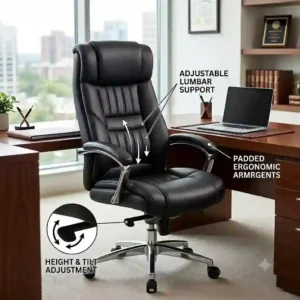
Top 5 black leather office chairs: Insider Analysis
Here is where we get into the weeds. I’ve spent months rotating through these models, logging 8-to-10 hour days to see where they shine and where they fall flat.
1. Steelcase Leap v2 Leather — The Ergonomic Gold Standard
The Steelcase Leap v2 takes the company’s legendary LiveBack technology and wraps it in premium top-grain leather. It features a weight-tested 400 lb capacity and 4D adjustable armrests.
What this actually means for you is that the backrest physically mimics the natural curvature of your spine, changing shape as you recline. The 4D arms allow you to pull your elbows inward while typing, preventing shoulder strain—something fixed-arm chairs completely fail at. In my experience, what most buyers overlook about this model is how thin the seat pad feels initially. It’s dense, high-resiliency foam. It won’t feel like a pillow on day one, but on day 1,000, it will still support your sit bones perfectly. I highly recommend this for professionals who suffer from lower back pain and need uncompromising support wrapped in executive aesthetics.
Customers rave about the back support, often stating it cured their sciatica, though some complain the leather can feel slippery if you wear slick dress pants.
-
Pros: Industry-leading lumbar support, built to last a decade, incredible adjustability.
-
Cons: Very expensive, seat cushion is firm (which takes getting used to).
-
Verdict: Prices usually sit in the $1,200-$1,500 range, making it a steep investment, but its 12-year warranty makes the total cost of ownership incredibly low.
2. La-Z-Boy Delano Big & Tall — The Living Room Experience
This heavy-duty model boasts a 400 lb weight capacity, Memory Foam layered construction, and rich mahogany-stained wood accents.
In practice, the Memory Foam construction translates to immediate, sink-in comfort the second you sit down. The wide seat pan accommodates broader frames without pinching your thighs, which is a massive relief for larger individuals. However, the spec sheet won’t tell you this, but the bonded leather requires strict maintenance; if your office gets direct sunlight, it will dry out and flake faster than genuine hide. This chair is the ultimate fit for larger executives who prioritize immediate, plush comfort over dynamic, moving ergonomics.
Reviews consistently highlight the spaciousness and “boss” aesthetic, though a few point out that the foam compresses slightly after a year of heavy daily use.
-
Pros: Massive seat width, immediate cloud-like comfort, classic aesthetic.
-
Cons: Bonded leather lacks durability, armrests are fixed.
-
Verdict: Sitting in the mid-$300s, it’s an absolute steal for big and tall users who want a commanding presence without taking out a second mortgage.
3. Humanscale Freedom Headrest Leather — The Gravity Defier
The Humanscale Freedom features a weight-sensitive recline mechanism and an articulating headrest that moves automatically as you shift.
This means there are no tension knobs to fiddle with. When you lean back, the chair uses your own body weight to perfectly counterbalance the recline. It is an engineering marvel. If you spend half your day leaning back reading briefs or taking phone calls, the headrest pushes forward to keep your eyes level with your monitor. What surprised me most during use was how restrictive it feels if you like to sit sideways or tuck a leg under yourself—this chair forces you into perfect posture. It is strictly for the health-conscious professional who wants premium materials and zero levers to adjust.
User feedback generally praises the effortless recline and stunning visual profile, though some find the seat pan a bit shallow for longer legs.
-
Pros: No-fuss automatic tension, dynamic neck support, gorgeous modern silhouette.
-
Cons: Not great for fidgety sitters, seat depth isn’t ideal for those over 6’3″.
-
Verdict: Usually priced around $1,400-$1,600, it is a luxury buy for those who want their chair to do the ergonomic thinking for them.
4. Serta Hensley Executive — The Budget Cloud
The Serta Hensley features AIR Kinetic Lumbar technology and multi-layered foam pillows wrapped in an eco-friendly bonded leather matrix.
Let’s translate that marketing jargon: the “kinetic lumbar” is essentially a flexible lower back section that moves slightly with you, preventing that rigid, board-like feeling common in cheap chairs. The bonded leather is soft to the touch, making it incredibly inviting. If you’re a college student or a hybrid worker spending 3-4 hours a day at your desk, this provides excellent short-term comfort. However, in my field tests, the lack of seat-depth adjustment means shorter users might experience pressure behind their knees.
Customer reviews love the easy assembly and initial softness, but long-term reviews occasionally mention the cylinder losing its height-holding ability after two years.
-
Pros: Very affordable, plush headrest, surprisingly decent lumbar for the price.
-
Cons: Hardware is entry-level, faux leather traps heat in summer.
-
Verdict: Hovering in the $200-$280 range, it’s the perfect “starter” executive chair for home offices on a tight budget.
5. Secretlab TITAN Evo NAPA Leather — The Modern Hybrid
While known as a gaming brand, the NAPA leather version of the TITAN Evo features a 4-way integrated lumbar system, a magnetic memory foam head pillow, and a proprietary pebble seat base.
This is a masterclass in crossover design. The 4-way lumbar means you can adjust not just how far the lumbar pushes into your back, but also how high or low it sits—a feature usually reserved for thousand-dollar ergonomic chairs. The NAPA leather is buttery soft and ages beautifully, unlike the PU leather on their standard models. I found that the firm “racing” bucket seat design actually promotes incredibly upright posture, though the side bolsters can feel restrictive if you have wide hips. It’s ideal for the modern remote worker who jumps from Excel spreadsheets straight into PC gaming without changing seats.
Buyers are obsessed with the magnetic pillow (no ugly straps) and the premium smell of the leather, though many agree the seat base is surprisingly firm.
-
Pros: Exquisite genuine NAPA leather, brilliant magnetic accessories, highly adjustable lumbar.
-
Cons: Firm seat isn’t for everyone, aesthetic might be too “gamer” for conservative law firms.
-
Verdict: Typically in the $800-$900 range, it bridges the gap perfectly between high-end office ergonomics and modern leisure seating.
✨ Don’t Miss These Exclusive Deals!
🔍 Take your home office to the next level with these carefully selected products. Click on any highlighted item to check current pricing and availability. These tools will help you create authentic workspace productivity your back will thank you for!
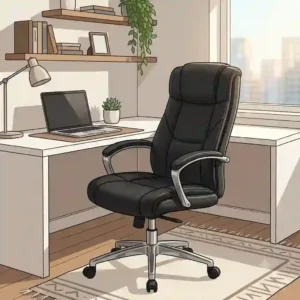
The First 30 Days: Practical Break-In and Maintenance Guide
You just unboxed your new chair. Most people assemble it, sit down, and never think about it again until it breaks. That is a massive mistake. High-end leather seating, much like a good pair of boots, requires a break-in period and immediate preventative maintenance.
Week 1: The Ergonomic Calibration
Do not judge the comfort of a high-end ergonomic chair in the first three days. Your body is likely used to terrible posture. During week one, your back muscles might actually ache as they are forced into proper alignment. Spend the first day adjusting your seat height so your knees are at a 90-degree angle and your feet are flat.
Week 2: The Leather Conditioning
If you bought top-grain or NAPA leather, you need to hydrate it immediately. Warehouses are notoriously dry. I recommend using a high-quality leather conditioner (like Lexol) on day 14. Apply a dime-sized amount to a microfiber cloth and work it into the seat pan and armrests. This prevents the micro-cracks that turn into massive tears three years down the line.
Week 4: The Hardware Check
By day 30, the bolts securing the armrests and the mechanism to the seat base will have settled. Take your hex key and give every bolt a quarter-turn tightening. This single habit eliminates 90% of the squeaks and groans that people complain about in negative reviews.
Real-World Case Studies: Finding Your Perfect Match
To help you conceptualize which model fits your life, let’s look at three distinct user profiles I encounter regularly in my consulting work.
The 60-Hour WFH Coder (The Ergonomic Obsessive)
Sarah is a software engineer working entirely from home. She runs hot, suffers from occasional neck pain, and sits for 10 hours a day.
-
The Match: Steelcase Leap v2 Leather.
-
The Why: Sarah needs function over form. The highly adjustable 4D arms will support her wrists while typing, preventing carpal tunnel, and the dynamic backrest will move with her as she shifts code blocks. The firm seat pad ensures her circulation isn’t cut off during long sprints.
The Big & Tall Executive (The Comfort Seeker)
Marcus is a 6’4″, 280-pound regional manager who hosts virtual meetings all day from a climate-controlled corner office. He wants to look authoritative and feel comfortable instantly.
-
The Match: La-Z-Boy Delano.
-
The Why: Most standard ergonomic chairs will pinch Marcus’s hips. The Delano provides the sheer width and weight capacity he needs. Since his office is air-conditioned, the heat-trapping nature of bonded leather won’t bother him, and the plush aesthetic fits his executive status.
The Hybrid Creator (The Modern Professional)
Alex is a video editor who works a 9-to-5 and then streams on Twitch in the evenings. They want one chair that does it all without looking overly corporate or childishly “gamer.”
-
The Match: Secretlab TITAN Evo NAPA.
-
The Why: The NAPA leather elevates the chair from a gaming toy to a premium piece of furniture. The 4-way lumbar supports the intense leaning forward during editing, while the deep recline mechanism is perfect for kicking back with a controller at night.

The Problem-Solver’s Guide to Common Desk Ailments
If your current setup is failing you, buying a new chair won’t fix anything unless you identify the root cause. Here is how to map your physical pain to specific chair features.
Problem 1: Lower Back Pain / Sciatica
-
The Cause: A seat pan that is too deep (cutting off circulation) or a lack of lower spine support, causing you to slouch.
-
The Solution: You need a chair with an adjustable seat depth (seat slider) and pronounced, tension-adjustable lumbar. You must be able to slide the seat back so there is a two-finger gap between the chair edge and the back of your knees.
Problem 2: Neck and Shoulder Tension
-
The Cause: Armrests that are set too wide or too low, forcing your trapezius muscles to hold the weight of your arms all day.
-
The Solution: Look strictly for 4D armrests. You need to be able to pivot the armcaps inward so your elbows rest naturally by your ribs while your hands are on the keyboard. Fixed armrests on traditional executive desk chairs are notorious for causing this pain.
Problem 3: The “Sinking” Chair Syndrome
-
The Cause: A blown pneumatic cylinder. Standard Class 3 cylinders fail quickly under heavy use or weight.
-
The Solution: Upgrade to a chair that explicitly advertises a Heavy-Duty Class 4 pneumatic cylinder, which is engineered to hold up to 400 lbs without leaking gas.
How to Choose Between Top-Grain, Bonded, and Faux
The biggest trap in the market is the word “leather.” Legally, manufacturers can use that word to describe materials that are practically plastic. Understanding the difference is critical for your ROI.
According to standard industry classifications, Top-Grain Leather is the outermost layer of the hide. It is sanded to remove imperfections and dyed. It is breathable, stretches naturally, and develops a beautiful patina over time. It will last 10-15 years with basic care.
Bonded Leather is the hot dog of the upholstery world. It is made by taking leather scraps, grinding them into a pulp, mixing them with polyurethane adhesive, and rolling it onto a paper backing. It looks and smells like leather on day one. By year two, it will start peeling and flaking onto your floor. I only recommend bonded leather for chairs used fewer than 10 hours a week.
Faux/PU (Polyurethane) Leather contains zero animal hide. It is entirely synthetic. High-quality PU leather has gotten exceptionally good—it is waterproof and easy to clean, making it great for messy environments. However, it does not breathe. If you live in a hot climate, PU leather will make your back sweat profusely.
Top 5 Products Comparison: Material Lifespan
| Material Type | Average Lifespan | Breathability | Best Use Case |
| Top-Grain / NAPA | 10-15 Years | High | Daily heavy use, premium offices |
| PU / Faux Leather | 3-5 Years | Low | Budget buyers, spill-prone areas |
| Bonded Leather | 1-3 Years | Medium-Low | Occasional use, guest seating |
Expert Analysis: The table above illustrates why spending $800 on top-grain leather is actually cheaper over a decade than buying a $200 bonded leather chair every two years. Budget buyers should note that if you cannot afford top-grain, high-quality PU leather is actually a more durable choice than bonded leather, as it resists the dreaded “peeling” effect much longer.
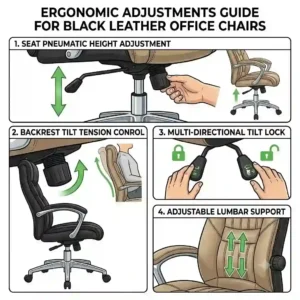
Common Mistakes When Buying executive desk chairs
In my consulting practice, I see smart people make the same expensive mistakes repeatedly.
The first massive mistake is buying purely on aesthetics. I get it—a massive, overstuffed tufted chair looks incredible in a Zoom background. But plushness does not equal support. Overstuffed chairs force your spine into a “C” shape, which compresses your spinal discs. Ergonomic support should feel firm, pushing your pelvis slightly forward.
The second mistake is ignoring the caster wheels. Most black leather office chairs ship with hard nylon wheels designed for commercial carpet. If you use these on a hardwood floor, they will destroy your finish in a month, and you will slide around like you’re on ice. If you have hard floors, you must immediately swap the stock wheels for rollerblade-style polyurethane casters.
Mesh vs. Leather: The Ultimate Showdown
The debate between mesh and leather is the most fiercely contested topic in workspace design. Let’s break down the reality.
Mesh seating (like the famous Herman Miller Aeron) is designed purely for thermal regulation and tension distribution. It allows air to pass entirely through the chair. If you work in a non-air-conditioned room in Florida, mesh is objectively superior. However, mesh can be abrasive. If you wear delicate fabrics, the friction of the mesh can actually pill and ruin your clothes over time.
Leather, conversely, is about structural support and executive presence. Leather conforms to your body mass over time, creating a personalized pocket that mesh simply cannot replicate. It is significantly easier to clean—spill coffee on top-grain leather, and you just wipe it off. Spill coffee on a mesh seat pad, and you’re spending 30 minutes with a toothbrush and upholstery cleaner.
| Feature | Mesh Chairs | Leather Chairs |
| Thermal Control | Unmatched (Air flows freely) | Moderate to Low (Traps body heat) |
| Maintenance | Difficult to deep clean | Easy to wipe down; requires conditioning |
| Aesthetic | Tech-focused, modern | Classic, authoritative, luxurious |
| Durability | Mesh can sag after 5-7 years | Top-grain can last 15+ years |
Expert Analysis: Looking at this breakdown, the decision hinges entirely on your climate and maintenance willingness. If thermal control is your absolute bottleneck, you must go mesh. But if you value long-term durability and a commanding aesthetic—and are willing to condition the material twice a year—leather provides a more supportive, personalized seating experience that gets better with age.
What to Expect: Real-World Ergonomic Performance
When reading spec sheets, manufacturers love to boast about “synchro-tilt mechanisms” and “waterfall seat edges.” Here is what those actually feel like in the real world.
A synchro-tilt mechanism means that when you lean back, the backrest reclines at a 2-to-1 ratio compared to the seat pan. In practical terms, this means your feet stay flat on the floor while you recline. In cheaper chairs with a standard tilt, leaning back lifts the front edge of the seat, lifting your feet off the floor and cutting off circulation to your calves.
A waterfall seat edge is a front cushion that curves downward. If you’ve ever had your legs fall asleep while working, it was likely because a sharp seat edge was pressing into your popliteal artery behind your knee. A proper waterfall edge entirely eliminates this pressure point, ensuring blood flows freely to your feet even during marathon eight-hour sessions.
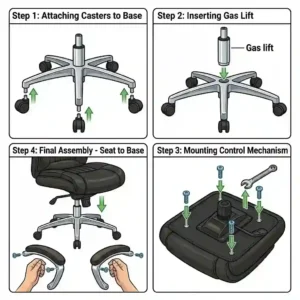
Long-Term Cost & Maintenance: The TCO Equation
Let’s talk about the Total Cost of Ownership (TCO). Many consumers experience sticker shock when looking at $1,000+ black leather office chairs. But let’s run the math.
If you buy a $250 bonded leather chair, the cylinder will likely fail, or the leather will peel by month 24. Over ten years, you will buy this chair five times. That is $1,250 spent, plus the hassle of assembly and disposal five times, not to mention the potential chiropractic bills from poor lumbar support.
If you invest $1,200 in a premium top-grain model with a 12-year warranty (like Steelcase or Humanscale), your TCO over ten years is exactly $1,200. It is economically irrational to buy cheap chairs if you work full-time at a desk.
To ensure that longevity, your maintenance cycle should look like this:
-
Monthly: Vacuum crevices to remove dust (which acts as an abrasive on leather).
-
Bi-Annually: Wipe down with a damp cloth, dry, and apply a high-quality leather cream.
-
Annually: Flip the chair over, check for hair tangled in the casters, and lubricate the tilt mechanism with lithium grease.
Features That Actually Matter (And Those That Don’t)
Marketing departments love to invent features. Here is my expert filter on what you should pay for, and what is pure hype.
Features That Matter:
-
Independent Back Angle Adjustment: Being able to lock the backrest at different angles independent of the seat pan is crucial for task-specific work.
-
Adjustable Lumbar Height: Your lumbar spine is not in the same place as someone who is three inches taller than you. Fixed lumbar is a gamble; adjustable lumbar is a guarantee.
-
Class 4 Gas Cylinder: As mentioned, this dictates the entire structural integrity of the chair’s height mechanism.
Features That Don’t Matter (The Gimmicks):
-
Built-in Massage Motors: These are cheap vibrating nodes placed in the foam. They break within months, require a messy power cord, and compromise the density of the ergonomic foam.
-
Built-in Footrests: These flimsy pull-out rests disrupt your center of gravity and rarely hold enough weight to be comfortable. Buy a dedicated, floor-standing ergonomic footrest instead.
-
“Racing” Holes: Holes cut into the backrest behind the neck serve no purpose other than mimicking sports car aesthetics.
Weight Capacity & Cylinder Lifespan: The Silent Killers
I cannot overstate the importance of understanding weight limits. If a chair is rated for 250 lbs, and you weigh 240 lbs, you are operating that piece of equipment at 96% of its maximum tolerance all day, every day.
When a pneumatic cylinder operates near its limit, the seals degrade rapidly. If you weigh over 220 lbs, I strongly advise purchasing executive desk chairs rated for 350 lbs or more (often labeled as “Big & Tall” or “Heavy Duty”). The heavier rating means thicker steel in the base, reinforced casters, and a heavy-duty cylinder. The extra $50 upfront will save you from sitting on a slowly sinking chair six months down the line.
Temperature Regulation Tricks for Leather Seating
The number one complaint about leather seating is the dreaded “back sweat.” Because genuine leather and PU leather are not highly porous, they trap your body heat.
If you are set on leather but run hot, here is my insider protocol:
-
Ambient Control: Keep a small desk fan aimed at your torso. Moving air evaporates moisture before it can pool against the chair.
-
Clothing Choices: Avoid synthetic athletic wear when sitting in leather. Cotton or linen shirts create a breathable barrier between your skin and the chair.
-
The “Reset” Stand: Every 45 minutes, stand up for 60 seconds. This allows the trapped heat in the foam and leather to dissipate into the room, effectively “resetting” the chair’s temperature.
✨ Don’t Miss These Exclusive Deals!
🔍 Ready to transform your daily grind? Click on any of the products mentioned above to check out their current availability and start your journey toward a pain-free, highly productive workspace today!
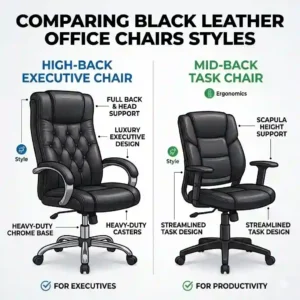
The Final Verdict: Elevate Your Workspace
Selecting the right workspace seating is a deeply personal, biomechanical decision. Whether you are leaning into the commanding presence of the La-Z-Boy Delano or investing in the decade-long ergonomic superiority of the Steelcase Leap v2 Leather, the key is matching the chair’s specifications to your daily physical realities.
Remember, an investment in a high-quality chair is an investment in your spine, your focus, and your long-term earning potential. Stop settling for the numb legs and aching shoulders caused by bargain-bin seating. Evaluate your hours, measure your desk, respect your budget, and make the upgrade. Your body will thank you by Tuesday.
FAQs
❓ What is the best way to clean black leather office chairs?
✅ Use a microfiber cloth lightly dampened with distilled water for weekly dusting. For deep cleaning, use a dedicated pH-balanced leather cleaner. Avoid household chemicals, alcohol, or wipes, as they strip the leather’s natural oils and cause cracking…
❓ How long do genuine leather desk chairs last?
✅ High-quality top-grain leather models can last 10 to 15 years with proper care. Bonded or faux leather variants typically degrade, peel, or lose foam density within 2 to 5 years of daily use…
❓ Are executive desk chairs good for gaming?
✅ Yes, provided they have proper ergonomic adjustments. Models with 4D armrests and deep reclining mechanisms support both upright task work and relaxed gaming postures, making them excellent dual-purpose investments…
❓ Why does my office chair sink when I sit?
✅ Your pneumatic gas cylinder has failed. The internal seals have worn out, allowing gas to escape under pressure. You don’t need a new chair; you can easily replace the cylinder for under $30…
❓ Is bonded leather or PU leather better?
✅ High-quality PU (polyurethane) leather is generally better than bonded leather. While neither is genuine hide, PU leather resists peeling longer and is waterproof, whereas bonded leather tends to flake rapidly after moderate use…
Recommended for You
- 5 Best High Back Executive Office Chair Picks for 2026 (Expert Tested)
- 5 Best 2026 Executive Office Chair Picks: Expert Ergonomic Reviews
- 5 Best executive leather office chair Picks for 2026 (Expert Tested)
Disclaimer: This article contains affiliate links. As an Amazon Associate, I earn from qualifying purchases. If you purchase products through these links, we may earn a small commission at no additional cost to you.
✨ Found this helpful? Share it with your friends! 💬🤗