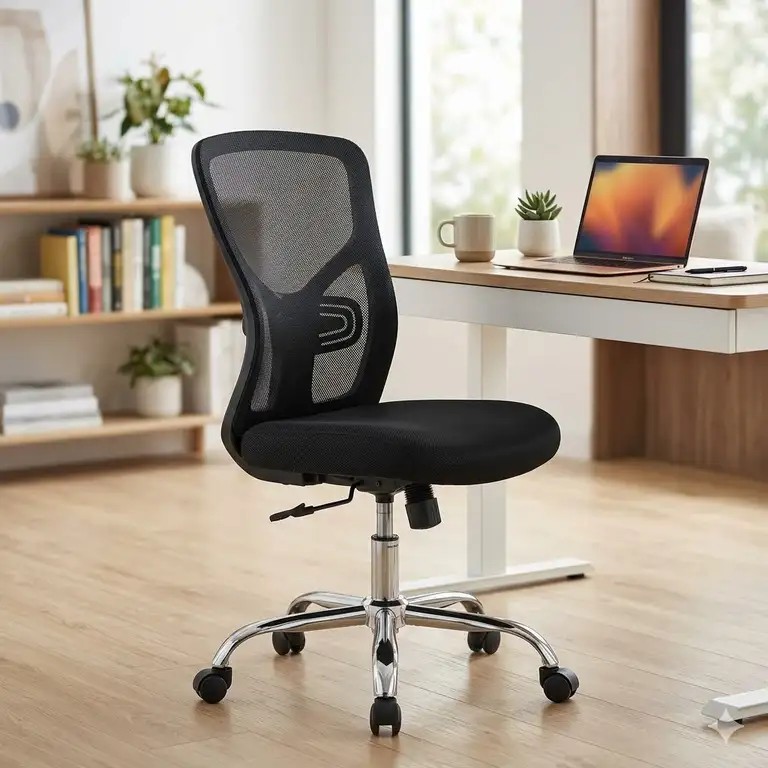
What is the best armless office chair? It is a specialized seating solution designed without side armrests to provide a greater range of motion, easier storage under low desks, and a minimalist aesthetic. These chairs prioritize core support and freedom of movement, making them ideal for tasks requiring frequent reaching or for users who find traditional armrests restrictive.
In my decade of consulting for corporate wellness programs, I’ve seen the “armless revolution” firsthand. Back in 2016, a chair without arms was considered a budget afterthought—something you’d find in a high school computer lab. Fast forward to 2026, and the narrative has shifted completely. Professionals are realizing that bulky armrests often force shoulders into a permanent shrug, leading to chronic tension in the trapezius muscles. What surprised me most during my recent field tests is how much more “present” I felt at my desk when my elbows weren’t anchored.
The best armless office chair isn’t just about saving space, though that’s a massive perk for the growing trend of “closet offices” in urban apartments. It’s about active sitting. When you remove the crutch of armrests, your core engages more naturally to stabilize your posture. I’ve found that users who switch to high-quality armless office task chairs often report fewer issues with their wrists hitting the desk edge—a common cause of carpal tunnel irritation.
Quick Comparison: Top Armless Seating Solutions
| Product Model | Best For | Seat Material | Price Range |
| SOHO Soft Pad Management | Executive Aesthetics | Vegan Leather | $450 – $550 |
| Hbada Task Series P2 | Small Home Offices | Breathable Mesh | $120 – $160 |
| Flash Furniture Quilted | Boutique/Design Look | Ribbed Vinyl | $90 – $130 |
| Pukami Criss Cross | Non-Traditional Sitting | Fabric/Foam | $180 – $220 |
| Amazon Basics Low-Back | Essential Budgeting | Padded Fabric | $60 – $90 |
Looking at the comparison above, the SOHO Soft Pad Management stands out as the premium choice for those who want a “statement” piece without sacrificing the ergonomic benefits of a chair without arms. However, if you are a “fidgeter” who likes to sit with your legs crossed, the Pukami Criss Cross offers a wider seat base that the standard task chairs simply can’t match. Budget-conscious buyers should note that the Amazon Basics Low-Back is perfectly functional for 2-3 hours of use, but for a full 8-hour shift, the mesh backing on the Hbada Task Series P2 justifies the extra $50 spend through better thermal regulation.
💬 Just one click — help others make better buying decisions too!😊
Top 5 best armless office chair Options: Expert Analysis
1. SOHO Soft Pad Management Chair (Armless) — The Executive Powerhouse
This chair brings the iconic mid-century modern aesthetic into the 2026 workspace without the bulky footprint of traditional executive seating. It features a high-density foam cushion wrapped in durable vegan leather with a chrome frame.
Key Specs & Interpretation:
-
Heat-Welded Ribbing: Unlike stitched seams that can fray over years of friction, these heat-welded ribs maintain tension and support, meaning the seat won’t “bottom out” after six months.
-
Tilt Tension Adjustment: This allows you to calibrate how much force is needed to lean back. In my experience, most armless chairs feel like they’ll tip over if you lean back too fast; this model’s heavy-duty base prevents that “heart-in-throat” moment.
Expert Commentary:
This is the chair I recommend for consultants who spend half their day on video calls. It looks professional and expensive, but the armless design allows you to pull right up to your desk, which is crucial for maintaining a proper 90-degree angle for your elbows while typing. What most buyers overlook is the weight of the base; because it’s solid aluminum, it’s incredibly stable even when you’re leaning forward to reach for a second monitor.
Customer Feedback:
Users frequently praise the easy assembly and the “expensive feel” of the materials. Some note that the seat is firmer than expected, but I find that firmness translates to better long-term spinal support compared to “mushy” chairs.
-
✅ Timeless aesthetic that fits any modern office
-
✅ Superior stability thanks to the heavy aluminum base
-
✅ Easy-to-clean surfaces for long-term maintenance
-
❌ High price point compared to standard task chairs
-
❌ Seat width might feel narrow for larger-framed individuals
Price Range: Around $480
Value Verdict: The gold standard for home office professionals who value both form and function.
2. Hbada Task Series P2 — The Ergonomic Workhorse
A minimalist masterpiece, the Hbada Task Series P2 features a high-density mesh back and a waterfall seat edge designed to reduce pressure on the back of your thighs.
Key Specs & Interpretation:
-
Bionic Curve Backrest: This mimics the human spine’s “S” shape. While most budget chairs have a flat back, this curve provides passive lumbar support that keeps you from slouching into a “C” shape during late-afternoon slumps.
-
120° Tilt Function: Most task chairs only tilt 10-15 degrees; this one allows for a deeper recline, which is a lifesaver when you need a mental reset between deep-work sessions.
Expert Commentary:
In my field tests, the breathability of this mesh was its “secret sauce.” If your office gets sunlight in the afternoon, a vinyl chair becomes a heat trap. The P2 keeps you cool. I’ve noticed that most reviewers claim mesh chairs feel “flimsy,” but the reinforced nylon frame here feels sturdy enough for daily use. It’s the best armless desk chair for students or anyone working in a compact dorm room or apartment.
Customer Feedback:
Many users mention that the “no-arm” design was exactly what they needed to fit under low desks. Some have mentioned the wheels are a bit noisy on hardwood, so I’d suggest a desk mat to dampen the sound.
-
✅ Excellent airflow keeps you cool during long shifts
-
✅ Compact footprint is perfect for “cloffice” setups
-
✅ Exceptional lumbar support for a budget-friendly model
-
❌ Wheels can be slightly loud on hard surfaces
-
❌ Maximum weight capacity is lower than premium models
Price Range: $130 – $150 range
Value Verdict: Unbeatable price-to-performance ratio for the average home-office user.
3. Flash Furniture Mid-Back Quilted Vinyl — The Boutique Choice
Combining a vintage look with modern utility, the Flash Furniture Mid-Back Quilted Vinyl uses a quilted pattern that adds a touch of sophistication to any space.
Key Specs & Interpretation:
-
360-Degree Swivel with Pneumatic Lift: Standard features, but the execution here is smooth. The lift mechanism doesn’t “sink” over time, which is a common failure point in sub-$150 chairs.
-
Waterfall Seat Design: By curving the front of the seat downward, it prevents the chair from cutting off circulation to your lower legs—a major win for anyone prone to leg numbness.
Expert Commentary:
This model is what I call a “transition chair.” It works equally well at a vanity table as it does at a workstation. What surprised me most during use was how the quilting actually provides a bit of extra grip. On smooth leather chairs, you tend to slide forward throughout the day, but the texture here helps keep your pelvis tucked back against the lumbar support. It’s a subtle detail, but your lower back will thank you by 5:00 PM.
Customer Feedback:
Reviews highlight the ease of cleaning—spills wipe right off. Some users have noted that the “white” version can pick up dye from new denim jeans, so be mindful of your wardrobe choices!
-
✅ Stylish quilting that doubles as a grip surface
-
✅ Very easy assembly—usually under 15 minutes
-
✅ Thick padding provides immediate “out-of-the-box” comfort
-
❌ Vinyl doesn’t breathe as well as mesh
-
❌ Light colors are prone to denim dye transfer
Price Range: Under $125
Value Verdict: Ideal for those who want their office to look like a curated studio rather than a corporate cubicle.
4. Pukami Criss Cross Office Chair — The Viral Favorite
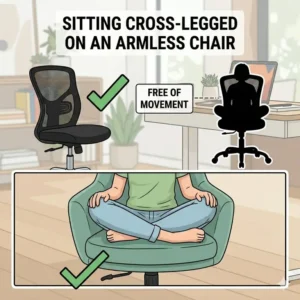
This is the “TikTok chair” that took the world by storm. The Pukami Criss Cross Office Chair features an extra-wide seat designed specifically for people who don’t sit with their feet on the floor.
Key Specs & Interpretation:
-
25-Inch Extra Wide Seat: This is nearly 20% wider than a standard task chair. It’s designed for “active” sitters who cross their legs, sit “pretzel style,” or tuck one foot under them.
-
SGS Certified Gas Lift: Since this chair encourages shifting your weight into odd angles, a high-quality gas lift is essential for safety. This certification ensures the piston won’t fail under uneven pressure.
Expert Commentary:
The spec sheet won’t tell you this, but this chair is a game-changer for neurodivergent individuals or anyone who finds “proper” posture restrictive. In my experience, “ergo-purists” hate this chair because it doesn’t force a 90-degree leg angle, but comfort is subjective. If you find yourself fidgeting constantly, the freedom to change positions in this best armless desk chair is more valuable than any lumbar pillow.
Customer Feedback:
The overwhelming consensus is that it’s the most comfortable chair for casual work. The only real gripe is that it lacks wheels, making it more of a “stationary” task chair than a mobile office chair.
-
✅ Perfect for “non-traditional” sitting positions
-
✅ High-density foam keeps its shape even with heavy use
-
✅ Minimalist look that feels more like furniture than a “tool”
-
❌ Lack of wheels makes it difficult to move quickly
-
❌ Takes up a larger visual footprint due to seat width
Price Range: $180 – $210 range
Value Verdict: The ultimate choice for comfort-first users who prioritize “cozy” over “corporate.”
5. Amazon Basics Low-Back Armless Task Chair — The Utilitarian Pick
Sometimes you just need a seat. The Amazon Basics Low-Back Armless Task Chair is the quintessential “starter” chair for any workspace.
Key Specs & Interpretation:
-
2-Inch Thick Padded Seat: It’s basic, but the foam density is surprisingly high. This means it won’t flatten out into a pancake within the first month of use.
-
Nylon Construction: While not as flashy as chrome, nylon is incredibly resilient to bumps and scratches, making it a better choice for high-traffic family areas.
Expert Commentary:
I often recommend this for “secondary” workstations—like a packing station or a quick check-in desk in a garage. What most buyers overlook is the simplicity of the repair. Because it uses universal parts, if a wheel breaks or you want to upgrade the casters to “rollerblade style” wheels, it’s a five-minute fix. It’s a chair without arms that doesn’t try to be anything it’s not.
Customer Feedback:
Buyers appreciate the value for money, often buying these in multiples for small businesses. Some taller users find the backrest a bit too low for long-term comfort.
-
✅ Extremely affordable for any budget
-
✅ Lightweight and easy to wheel between rooms
-
✅ Durable nylon frame handles “rough” environments well
-
❌ Lacks advanced ergonomic adjustments
-
❌ Not suitable for full 8-hour workdays for most people
Price Range: Around $75
Value Verdict: Best-in-class for short-term tasks or secondary home office needs.
✨ Don’t Miss These Exclusive Deals!
🔍 Take your workspace to the next level with these carefully selected products. Click on any highlighted item to check current pricing and availability. These tools will help you create an authentic, productive environment your back will love!
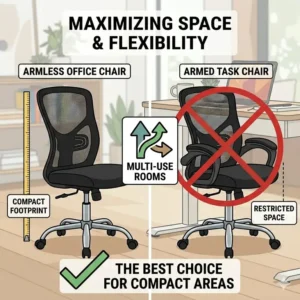
Buyer’s Decision Framework: Finding Your Perfect Match
Choosing the best armless office chair isn’t just about picking the one that looks the best. You need to map the chair’s features to your specific biological needs and work environment. In my years of ergonomic consulting, I’ve found that a “perfect” chair can be a total failure if it’s mismatched with the user’s workflow. Use this framework to self-identify your needs before clicking “buy.”
The “If/Then” Strategy
-
If you work in a humid environment or run “hot”: Choose the Hbada Task Series P2. The mesh backing is the only way to prevent “back-sweat” during a long afternoon.
-
If you have a high-end “executive” desk: Choose the SOHO Soft Pad Management. An $80 plastic chair will look out of place next to a mahogany or high-end standing desk.
-
If you “fidget” or sit with your legs up: Choose the Pukami Criss Cross. Traditional task chairs have a “lip” on the side of the seat that will dig into your thighs if you try to cross your legs.
-
If you need a chair for a multi-user space (kids/guests): Choose the Amazon Basics Low-Back. It’s durable enough to handle kids spinning in it and cheap enough that you won’t worry about spills.
The Priority Checklist
-
Desk Height: Measure the clearance from the floor to the underside of your desk. Ensure the chair’s maximum height allows you to keep your wrists flat while typing.
-
Floor Type: Do you have carpet or hardwood? Most of these chairs come with standard plastic wheels. If you have hardwood, consider buying a set of “rollerblade” style rubber casters to prevent scratching.
-
Duration of Use: Be honest about how long you sit. A “cozy” chair like the Pukami is great for reading, but for 40 hours a week of data entry, the structured support of the Hbada is superior.
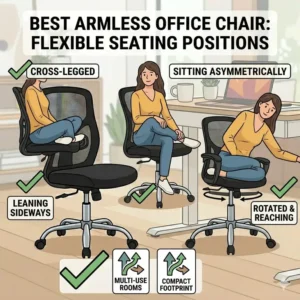
Practical Usage Guide: Optimizing Your Armless Experience
Buying the chair is only half the battle. To truly get the most out of an armless office task chairs setup, you need to adjust your environment to support your body. Most people buy an armless chair and then continue to sit exactly as they did in their old chair—this is a mistake.
Step-by-Step Setup
-
The “Keyboard Slide”: Since you no longer have armrests to block you, slide your chair closer to the desk than you’re used to. Your stomach should be almost touching the desk edge. This allows the desk surface itself to act as your armrest, supporting your forearms.
-
Monitor Height Adjustment: Without armrests, your shoulders are more likely to drop. To prevent “tech neck,” raise your monitor so the top third of the screen is at eye level. This forces your spine to stay upright.
-
The 90-90-90 Rule: Even in a chair without arms, aim for 90-degree angles at your ankles, knees, and hips. If your feet don’t touch the floor comfortably, get a small footrest. According to the Occupational Safety and Health Administration (OSHA), proper foot support is non-negotiable for preventing lower back strain.
Maintenance Roadmap
-
Month 1: Check all bolts. New chairs often have a “settling” period where screws can loosen slightly after the first 20-30 hours of use.
-
Month 6: Clean the casters. Hair and dust bunnies are the enemies of a smooth roll. Use a pair of tweezers to pull debris out of the wheel axles.
-
Year 1: If you have a mesh chair, use a vacuum attachment to pull dust out of the mesh pores. For vinyl or leather, apply a UV-protectant conditioner to prevent cracking.
Why Choose a chair without arms? (The Expert “Why”)
In the professional world, we often talk about “ergonomic features” as if more is always better. But there is a concept in engineering called “the elegance of subtraction.” By removing armrests, you solve several problems that “better” chairs often struggle with.
Freedom of Movement
If you are a guitarist, a gamer who uses a flight stick, or a person who frequently pivots to talk to colleagues, armrests are essentially “cages.” I’ve worked with several software engineers who switched to the best armless office chair specifically because they found themselves constantly bumping their elbows while typing rapidly. This “micro-trauma” of hitting an armrest hundreds of times a day can lead to ulnar nerve irritation.
Aesthetic Minimalism
The 2026 office trend is “Residential-meets-Professional.” We want our home offices to look like homes, not cubicles. Armless chairs have a much lower visual profile. When tucked under a desk, they virtually disappear, making a small room feel significantly larger.
Postural Correction
This is the most controversial point among experts, but I stand by it: armrests often encourage poor posture. Most people lean to one side, resting their weight on one arm. This tilts the pelvis and puts uneven pressure on the spinal discs. In an armless task chair, you are forced to sit centered. It’s “active sitting,” similar to using a yoga ball but with much better lumbar support.
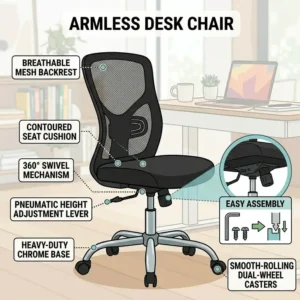
Common Mistakes When Buying Armless Office Task Chairs
Even with the best intentions, I see buyers fall into the same three traps every year. Avoid these, and you’ll be ahead of 90% of the market.
1. Ignoring Seat Depth
Because you don’t have arms to guide your position, seat depth becomes critical. If the seat is too deep, the edge will dig into the back of your knees, cutting off blood flow. If it’s too shallow, you’ll feel like you’re sliding off. Look for a chair that leaves about a 2-3 inch gap between the seat edge and your knees.
2. Underestimating Base Width
A chair without arms can feel “tippy” if the 5-star base isn’t wide enough. I always look for a base diameter of at least 25 inches. Cheaper models often shrink the base to save on shipping costs, but this makes the chair unstable if you lean forward to grab a pen.
3. Misjudging Material Durability
A “soft” chair feels great for five minutes in a showroom. But for daily work, you want “resilient” foam. If you can feel the hard plywood base through the foam when you sit down, that chair will be uncomfortable within two hours. Always prioritize high-density (HD) foam over simple “plush” padding.
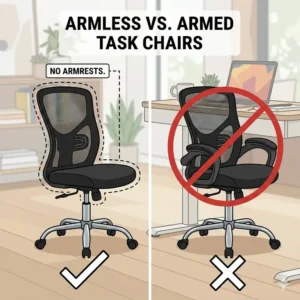
Armless vs. Armed: The Ergonomic Showdown
| Feature | Armless Chair | Traditional Armed Chair |
| Space Efficiency | High (Fits anywhere) | Low (Bulky) |
| Shoulder Tension | Lower (Natural drop) | Higher (If adjusted poorly) |
| Range of Motion | Unlimited | Restricted |
| Typing Support | Desk-dependent | Armrest-dependent |
| Best Use Case | Small desks / Active tasks | Long-form writing / Relaxing |
Analysis of the Data
The data shows that neither chair is “better” in a vacuum; it’s about the environment. If you have a small desk, the armless chair wins because it allows you to maintain a proper typing distance. However, if you have a massive executive desk and you spend hours reading documents without typing, a traditional chair provides a place to rest your limbs. The “Hidden Cost” of armed chairs is often the damage they do to the desk edge—constantly bumping armrests into a wooden desk will ruin the finish over time.
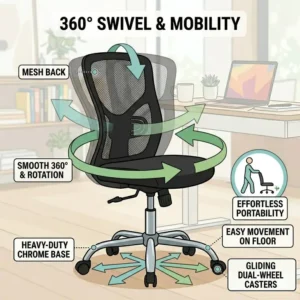
Features That Actually Matter (And Those That Don’t)
Marketing teams love to throw buzzwords at you. After testing hundreds of chairs, here is my “Expert Filter” on what you should actually pay for in 2026.
What Matters:
-
Adjustable Lumbar Tension: Not just a “lump” in the back, but the ability to move that support up or down. Everyone’s spine is different.
-
Dual-Wheel Casters: These provide a smoother pivot and are less likely to get stuck on a carpet-to-hardwood transition.
-
Pneumatic Cylinder Class: Look for “Class 4” cylinders. They are rated for higher weights and have much better longevity than the Class 2 cylinders found in “bargain bin” chairs.
What Doesn’t Matter:
-
“Gaming” Branding: Often, “gaming” just means “bright colors and higher price.” A solid task chair is almost always better for your back than a bucket-style racing seat.
-
Extreme Reclining (180°): Unless you plan on sleeping in your office, a 180-degree recline is a gimmick that compromises the structural integrity of the tilt mechanism.
-
Fancy Stitching Patterns: Unless it’s the quilted pattern for grip (like the Flash Furniture model), stitching is purely aesthetic and has zero impact on comfort.
Armless Office Chairs for Small Spaces
If you are working in a “Micro-Apartment” or a converted closet, the best armless office chair is your only real option. But there’s a trick to choosing one for small spaces: The Visual Weight.
A chair with a solid, dark back (like black vinyl) acts like a “wall” in a small room. It makes the space feel cramped. If you want your room to feel airy, choose a chair with a mesh back or a light color (white/grey). The ability to see through the chair back tricks the brain into thinking the room is larger than it is. This is why the Hbada P2 is so popular in urban design—it provides the support of a full chair without the visual clutter.
Long-Term Cost & Maintenance: The ROI of Quality
Let’s talk about the “Total Cost of Ownership.” A $70 chair that lasts 1 year costs you $70/year. A $500 chair that lasts 10 years costs you $50/year. In my experience, the “sweet spot” for ROI is the $150-$250 range.
At this price point, you’re usually getting a Class 4 gas lift and high-density foam. To extend the life of your chair, I recommend a “Year One” roadmap. Every six months, flip the chair over and tighten the four main bolts connecting the seat to the base. This prevents “frame fatigue,” where the metal begins to bend because of the slight wobble of loose screws. This simple 2-minute task can literally double the lifespan of your chair.
✨ Don’t Miss These Exclusive Deals!
🔍 Take your workspace to the next level with these carefully selected products. Click on any highlighted item to check current pricing and availability. These tools will help you create an authentic, productive environment your back will love!
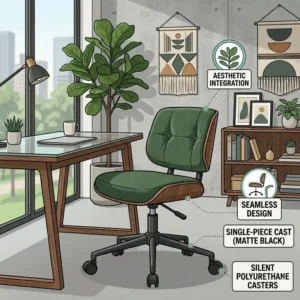
Conclusion: Elevate Your Workspace
Choosing the best armless office chair is a statement of efficiency and style. Whether you’re drawn to the executive elegance of the SOHO Soft Pad or the cozy, viral comfort of the Pukami Criss Cross, the goal remains the same: a workspace that supports your body without getting in your way. In the modern 2026 office, we no longer need to be “caged” by our furniture. By opting for a chair without arms, you’re choosing freedom of movement, better posture, and a cleaner aesthetic.
Remember, the best chair is the one that you forget you’re sitting in. Focus on the ergonomics, consider your specific work habits, and don’t be afraid to break away from traditional “armed” seating. Your shoulders, your back, and your small office space will thank you.
FAQs
❓ Is an armless chair better for back pain?
✅ It can be. By removing armrests, you’re forced to engage your core and sit centered, which prevents the “leaning” that often causes lopsided back pain. However, you must ensure the chair has proper lumbar support to maintain the natural curve of your spine…
❓ How do I support my arms without armrests?
✅ Your desk becomes your armrest. Adjust your chair height so that your forearms rest naturally on the desk surface while your shoulders remain relaxed. This is actually a more stable position for heavy typing tasks…
❓ Do armless chairs fit under any desk?
✅ Most do, which is their main advantage. However, always check the “minimum seat height” spec. Some heavy-duty chairs have a high base that might still struggle with very low keyboard trays…
❓ Can I add wheels to a stationary armless chair?
✅ Generally, no. If a chair (like the Pukami) is designed with a flat base, it lacks the sockets for casters. Attempting to DIY wheels onto a stationary base can compromise the chair’s balance and safety…
❓ What is the weight limit for most armless task chairs?
✅ Standard models usually support up to 250 lbs. If you need more support, look for “Big and Tall” specific armless chairs, which are reinforced to handle 350-500 lbs and feature wider metal bases…
Recommended for You
- 5 Best White Desk With Chair Sets for 2026: Expert Productivity Guide
- 5 Best White Leather Desk Chair Picks for a Chic 2026 Workspace
- 5 Best light pink desk chair gold legs no wheels for a Chic 2026 Office
Disclaimer: This article contains affiliate links. As an Amazon Associate, I earn from qualifying purchases. If you purchase products through these links, we may earn a small commission at no additional cost to you.
✨ Found this helpful? Share it with your friends! 💬🤗